Showing posts with label lasik eye surgery faq. Show all posts

Thursday, May 1, 2014

Anyone have any success stories with Lasik/laser eye surgery/correction?


mummaamand


I H-A-T-E my contacts (and have for about 6 years!) and am fed up; looking into eye surgery but wanted to hear about others' experiences with it. Thanks!


Answer
The vast majority of people who have Lasik or similar laser eye surgery are satisfied with the results, but Lasik is surgery and all surgery has some element of risk.

I work for a nonprofit Lasik patient advocacy. We don't provide Lasik; we just provide Lasik information and certification of Lasik doctor who meet our patient outcome requirements.

Our organization's Quality Standards Advisory Committee evaluated peer-reviewed medical journal articles, FDA clinical trials, and literally thousands of patient outcomes to determine that about 90% of refractive surgery patients (all types of surgery, all types of patients) achieve 20/40 or better with about 65% achieving 20/20 or better. About 3% have some sort of unresolved problem at six months postop with 0.5% being serious problems.

http://www.usaeyes.org/lasik/faq/do-it.htm

If you hate your contacts because they are uncomfortable, then you may actually have a problem with poor contact lens fitting or dry eye. All dry eye issues should be treated and managed before having Lasik.

http://www.usaeyes.org/lasik/faq/lasik-dry-eyes.htm

An active bulletin board for Lasik patients is at...

http://www.usaeyes.org/ask-lasik-expert/

...where you can read the experiences of others.

Has anyone ever had Lasik eye surgery paid for as a medical procedure?

Q. I seem to be allergic to every pair of glasses that I have tried. I get horrible rashes around my eyes. It is either something in the metal and/or something that the plastic is treated with. Also, when it's sunny it makes my eczema flair up. A Dr. who does Lasik procedures said I could ask my PCP to refer me for a procedure, but I don't think it would fly.

I have tried contacts, but I am far-sighted in one eye and near-sighted in the other eye. They didn't work. Everything was blurry.


Answer
It is rare that a major medical insurance plan has in place a policy to pay for refractive surgery in a situation like yours, but that is what the appeal process is all about.

I work for a nonprofit Lasik patient advocacy. We do not provide Lasik. We provide Lasik information and certify Lasik doctors' patient outcomes.

In 1999 our organization developed a position statement for refractive pathology - when normally elective surgery like Lasik would be a medical necessity. Your allergies and unsuccessful contact lens use would be consistent with our policy.

http://www.usaeyes.org/faq/subjects/refractive_pathology.htm

Our position statement does not have the force of law, but it sets the guidelines that medical insurance companies have voluntarily accepted.

The first step of your process would be to go to your primary care provider and explain your problems. A history of treatment for allergy due to glasses will help affirm your claims. The PCP would probably send you to an allergist and/or an ophthalmologist for evaluation. If those specialists confirm your situation and that you are an appropriate candidate for Lasik, the next step would be to ask the insurance plan for coverage. Expect it to be automatically denied, but there is always an appeal process.

If you lose the appeal, most states have an arbitration process through the agency that regulates the medical plan. That would be your next step.

Seek the help of your human resources department if you receive your insurance through your employer. They may have a bit more clout than just you as a beneficiary.


Powered by Yahoo! Answers

Read more...

Thursday, April 24, 2014

LASIK eye Surgery?? ?


starry


You have to be 18 to get the surgery, right? I'm only 17 but I am truly blind without my contacts or glasses and I hate this feeling. I have been living like this all my life. Is the surgery safe for anyone and everyone? What are the pros and cons? I am really hoping to get this done next summer and am saving money. How much is it normally? I heard prices went down.


Answer
It is not just your chronological age that matters, it is your eyes' stability. You need to have a stable eye prescription for at least two years.

Lasik is not for everyone. It is medically safe and effective, however all surgery has risks. You may find the preliminary results of the USAEyes CORE patient survey interesting:

http://www.usaeyes.org/lasik/faq/lasik-results-1.htm

There are many pros and cons, but you really won't know what applies to you until you have had a comprehensive examination from a competent eye doctor.

Prices range from about $299 to $2500 per eye, but the national average is about $1,750 per eye. The cost may depend upon your exact needs. Financing is commonly available.

http://www.usaeyes.org/lasik/faq/lasik-cost-price.htm

You may want to browse around our website and learn about Lasik and similar laser vision correction surgery.

Speech topics niagara falls or lasik eye surgery?


va98


im doing a final speech and im probably going to pick one of these topics to do a informative speech that has a powerpoint and is 8 minutes long
which do you think would be a better topic and would be easier to expand on and show pictures of
thanks


Answer
Lasik will, by far, give you more material to consider and present.

http://www.usaeyes.org/lasik/faq/lasik.htm


Powered by Yahoo! Answers

Read more...

Sunday, January 26, 2014

Can you tell if someone has gotten laser eye surgery just by looking at their eyes?

lasik eye surgery faq
 on Lasik eye surgery: laser eye surgery, lasik cost, cost lasik eye, Find ...
lasik eye surgery faq image


redran


If someone gets laser eye surgery, is there a way for another person or doctor to be able to tell by only looking at their eyes? As in they have no files on you or any past history of your eyes? Thanks in advance :)


Answer
An eye doctor would be able to determine if someone has had laser eye surgery upon a comprehensive examination. You can't hide Lasik from everyone, but the average person is not likely to notice the change in the shape of the cornea or the location of the Lasik incision after the normal six month healing period. The cornea heals clear and except for a slightly altered corneal shape, Lasik is virtually invisible.

http://www.usaeyes.org/lasik/faq/lasik.htm

Will LASIK surgery prevent you from riding a roller coaster?


AlanIH


I heard that if you have LASIK surgery, you can no longer ride a rollercoaster, pilot an airplane, or even ride a car with the top down. The so-called reason is that the flap in your eye created by the laser might open up again or come loose in the event of high-G forces or gusts of wind. Is this really true? I love roller coasters but am thinking about getting LASIK myself and would love to know the true answer to this myth.


Answer
Good heavens. Someone is apparently trying to scare you away from Lasik, is completely uninformed, or both.

I work for a nonprofit Lasik patient advocacy. We don't provide Lasik. We provide Lasik information and certify Lasik doctors' patients' results.

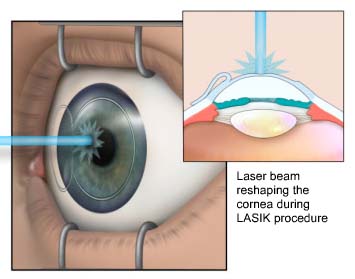
The first step in Lasik laser vision correction is to create a thin flap of corneal tissue. The flap is moved aside, laser energy is applied, and then the flap is repositioned over the treatment area. By applying the laser energy to the inner portion of the cornea the eye is "fooled" into not realizing it has had surgery. This mutes the wound response and contributes to Lasik's rapid vision recovery and general lack of pain.

http://www.usaeyes.org/lasik/faq/lasik.htm

Within minutes of flap repositioning the flap has adhered to the underlying cornea due to the natural suction created by the cornea absorbing oxygen into the eye. This is why you can blink immediately after Lasik and not dislodge the flap.

Within a few days a seal around the edge of the flap begins to form. This seal eventually acts like the lid on a Tupperware bowl to strongly adhere the flap to the underlying corneal surface. For a detailed explanation of the Lasik flap healing process visit:

http://www.usaeyes.org/lasik/faq/lasik-flap-heal.htm

The United States military has approved Lasik for fighter pilots, who experience significantly greater G-forces than you would experience on a roller coaster. Special service branches of the military, such as Navy SEALS are able to have Lasik. This is a group in extreme environments. At a recent US Food and Drug Administration hearing David J. Tanzer, M.D., Commander, Medical Corps, US Navy, and a Lasik surgeon extolled the virtues of Lasik and similar refractive surgery for US troops.

http://tinyurl.com/3s6x3y for Dr. Tanzer's presentation to the FDA.

There are about 1 million Lasik surgeries throughout the world each year. If the Lasik flap was going to flap in the wind when riding in a convertible with the top down, don't you think you would have heard about it on the news? I suspect that if Tiger Woodsâ Lasik flap dislodged â or the flap of other prominent sports personalities, movie stars, police, fire fighters, and others who have had successful Lasik - you would hear about it.

Although the Lasik flap does heal, the cornea is always different after Lasik. Once you have had Lasik, you have always had Lasik. Significant trauma to the eye can dislodge the Lasik flap. Fortunately this is relatively rare and if the flap is intact it can commonly be repositioned and will heal.

If you are involved in activities and sports where trauma to the face and eyes is very likely, such as a professional fighter, then Lasik may not be appropriate because of the high probability that you will suffer blows to the eye. Even if a problem is unlikely, it seems prudent to consider Lasik alternatives such as PRK, LASEK, and Epi-Lasik. These techniques, commonly known as surface ablation, do not require the Lasik flap. The patient will have a much longer vision recovery and more discomfort, but laser vision correction without a flap is available.


Powered by Yahoo! Answers

Read more...

Saturday, November 2, 2013

Does having lasik eye surgery disqualify you from the military?

Read more...

Wednesday, October 2, 2013

Can I have wavefront lasik surgery for Navy SEALS?

lasik eye surgery faq
 on LASIK Eye Surgery FAQs
lasik eye surgery faq image


Joshua


I know that LASIK is approved before going into BUD/S but is wavefront lasik surgery approved? Also can you just have the surgery by yourself and wait 6 months until you enlist and apply for BUD/S or do you have to get a waiver from WEPS before doing the surgery? Please help. Thanks!


Answer
BUD/S is a 6-month US Navy special operations SEAL training course held at the Naval Special Warfare Training Center in Coronado, CA.

Wavefront is a method of mapping higher order aberrations to help guide the excimer laser during Lasik. Conventional laser guidance uses a patient's eyeglass prescription. A wavefront analysis looks at nuances of the patient's vision. Think of the image of a square grid entering the eye. The eye's natural aberrations cause the grid to end up wavy by the time it is focused on the retina and "seen". Wavefront guided Lasik attempts to make corrections so a square grid enters the eye and a square grid is seen at the retina.

http://www.usaeyes.org/lasik/faq/lasik-wavefront-custom.htm

A waiver is necessary for vision correction surgery. No special waiver is required for wavefront-optimized vision correction surgery as opposed to conventional vision correction surgery.

You are more likely to gain a waiver for PRK than for Lasik, although the Navy has approved Bladeless Lasik for Top Gun pilots and you might get a Lasik waiver. Vision recovery is slower with PRK, but there is a lower probability of complications, especially long term.

As of 19 February 2009, BUD/S candidates' worst eye can be no worse than 20/70, best eye no worse than 20/40 and both eyes correctable to 20/25 or better. Whether or not you need to have vision correction surgery to be able to enter BUD/S depends upon your current refractive error.

It would probably be advantageous to have the military provide laser vision correction rather than going to an independent Lasik surgeon. That way the military is responsible for the outcome and its effect upon your ability to serve.

Good luck with BUD/S. The washout rate is about 80%.It is a grueling program.

Read:
http://www.med.navy.mil/sites/nmcsd/patients/pages/refractivesurgerycenter.aspx

Reference:
CNO Washington DC 212221Z Dec 99 (NAVADMIN 341/99) Photorefractive Keratectomy Surgery Program for Active Duty Service Members;
NAVMED P-117, Manual of Medical Department;
BUMED Washington DC 0613444Z Apr 00 Corneal Refractive Surgery Physical Standards and Waiver;
NAVMED Policy 07-001 Policy Guidance on LASIK (Laser in-situ Keratomileusis) of Oct 06;
NAMI Aeromedical Reference and Waiver Guide, Current Edition;

When should I get laser eye surgery in the Marines?


Thomas Hob


If I go through the NROTC program and go to OCS and intend to become a Marine Pilot, when should I declare I want to go into the air option? And when should I get vision corrective surgery in that process?
Note: The navy does allow people with lasik to serve as pilots if they enter into a certain study and get a waiver.


Answer
It is not considered a good idea to get any type of laser eye correction before 20 years old because the vision has not yet stabilized. It can get worse after the surgery.
Q: Can I be guaranteed flight school after graduation?
A: The Navy does not give such a guarantee. However, experience has shown that a solid academic performance at Colorado, and high scores on the aviation aptitude exam, plus being physically qualified for aviation, will give a Midshipman an excellent chance of getting aviation. The Marine Corps does offer flight guarantees, which can be granted by meeting the requirements any time up to 90 days before graduation.
http://www.colorado.edu/NROTC/faq.html
"AVIATION APPLICANTS
Applicants who desire to apply for a guaranteed position in aviation must pass two additional requirements, a cycloplegic eye exam and the Aviation Selection Test Battery (ASTB). Aviators (pilots) must have 20/40 or better vision in each eye. However, as of 1 June 2005, applicants outside those requirements may apply for a contact lens waiver. Applicants must have uncorrected vision better than 20/400 and be correctable to 20/20 with soft contacts. In addition, they must be able to show they�ve worn soft contacts for at least six months without any type of problems. Naval Flight Officers (co-pilots/navigators) must simply have vision correctable to 20/20. Applicants who have had their vision surgically corrected should be aware that only vision correction through the PRK (Photorefractive Keratectomy) procedure is eligible for aviation. Applicants who has had their vision corrected through the LASIK (Laser Assisted In Situ Keratomileusis) procedure are disqualified for aviation, but may apply for the ground or law program."
http://und.edu/org/mao/MarineProgams.pdf


Powered by Yahoo! Answers

Read more...

Wednesday, August 21, 2013

How good of vision do I need to become a pilot or get into the Air Force?

lasik eye surgery faq
 on LASIK Eye Surgery Questions to Ask Your Eye Doctor : Key-Whitman Eye ...
lasik eye surgery faq image


Nate


I've heard that you need 20/20 vision in each eye, but can you have laser surgery? What are the requirements? Thanks


Answer
Research? As in.....external sources? What a great idea!
http://www.airforce.com/contact-us/faq/eligibility/#qualifications-to-fly
Distant visual acuity to be not more than 20/70 each eye correctable to 20/20
Corrective eye surgery could be a disqualifier
Looks like it's not as simple as 20/20 or get lasik....
http://www.afrotc.com/admissions/requirements-standards/medical/
Their other site says the same thing. Air Force's own sites....
http://www.e-publishing.af.mil/
Go to this site and find AFI48-123 Medical Examinations and Standards for all the details. Looks like the vision standards start around pg 80.
http://ecfr.gpoaccess.gov/cgi/t/text/text-idx?c=ecfr&sid=d163a98d025ced8c6166ea13398879e6&rgn=div8&view=text&node=14:2.0.1.1.5.2.1.2&idno=14
Civil pilot rules are online too.

Don't trust Yahoo! Guesses for career or medical decisions. Contact the USAF directly to verify that the info is correct and current or for other questions.

Cleveland area lasik eye surgery doctors?


Stacey M


I am just begining research on Laser Eye Surgery. I am origianlly from Louisiana and don't know anything about the doctors in the cleveland area that perform this procedure. I have heard that the Cleveland Clinic prides itself on what a great job it does and that people come from all over the world to have eye surgeries done there. If anyone can give me any suggestion or has any info about the cleveland clinic or can recommend any doctor I would appreciate it.


Answer
I recommend you use our 50 Tough Questions For Your Lasik Doctor to help evaluate a potential surgeon at the Cleveland Clinic. I believe you will find the senior surgeon there will pass with flying colors.

http://www.usaeyes.org/lasik/faq/lasik-tough-questions.htm


Powered by Yahoo! Answers

Read more...

Monday, August 5, 2013

Does having lasik eye surgery disqualify you from the military?

Read more...

Thursday, July 25, 2013

Can you tell if someone has gotten laser eye surgery just by looking at their eyes?

lasik eye surgery faq
 on Lasik Eye Surgery Information - Lasik Surgery Questions Answered
lasik eye surgery faq image


redran


If someone gets laser eye surgery, is there a way for another person or doctor to be able to tell by only looking at their eyes? As in they have no files on you or any past history of your eyes? Thanks in advance :)


Answer
An eye doctor would be able to determine if someone has had laser eye surgery upon a comprehensive examination. You can't hide Lasik from everyone, but the average person is not likely to notice the change in the shape of the cornea or the location of the Lasik incision after the normal six month healing period. The cornea heals clear and except for a slightly altered corneal shape, Lasik is virtually invisible.

http://www.usaeyes.org/lasik/faq/lasik.htm

Will LASIK surgery prevent you from riding a roller coaster?


AlanIH


I heard that if you have LASIK surgery, you can no longer ride a rollercoaster, pilot an airplane, or even ride a car with the top down. The so-called reason is that the flap in your eye created by the laser might open up again or come loose in the event of high-G forces or gusts of wind. Is this really true? I love roller coasters but am thinking about getting LASIK myself and would love to know the true answer to this myth.


Answer
Good heavens. Someone is apparently trying to scare you away from Lasik, is completely uninformed, or both.

I work for a nonprofit Lasik patient advocacy. We don't provide Lasik. We provide Lasik information and certify Lasik doctors' patients' results.

The first step in Lasik laser vision correction is to create a thin flap of corneal tissue. The flap is moved aside, laser energy is applied, and then the flap is repositioned over the treatment area. By applying the laser energy to the inner portion of the cornea the eye is "fooled" into not realizing it has had surgery. This mutes the wound response and contributes to Lasik's rapid vision recovery and general lack of pain.

http://www.usaeyes.org/lasik/faq/lasik.htm

Within minutes of flap repositioning the flap has adhered to the underlying cornea due to the natural suction created by the cornea absorbing oxygen into the eye. This is why you can blink immediately after Lasik and not dislodge the flap.

Within a few days a seal around the edge of the flap begins to form. This seal eventually acts like the lid on a Tupperware bowl to strongly adhere the flap to the underlying corneal surface. For a detailed explanation of the Lasik flap healing process visit:

http://www.usaeyes.org/lasik/faq/lasik-flap-heal.htm

The United States military has approved Lasik for fighter pilots, who experience significantly greater G-forces than you would experience on a roller coaster. Special service branches of the military, such as Navy SEALS are able to have Lasik. This is a group in extreme environments. At a recent US Food and Drug Administration hearing David J. Tanzer, M.D., Commander, Medical Corps, US Navy, and a Lasik surgeon extolled the virtues of Lasik and similar refractive surgery for US troops.

http://tinyurl.com/3s6x3y for Dr. Tanzer's presentation to the FDA.

There are about 1 million Lasik surgeries throughout the world each year. If the Lasik flap was going to flap in the wind when riding in a convertible with the top down, don't you think you would have heard about it on the news? I suspect that if Tiger Woodsâ Lasik flap dislodged â or the flap of other prominent sports personalities, movie stars, police, fire fighters, and others who have had successful Lasik - you would hear about it.

Although the Lasik flap does heal, the cornea is always different after Lasik. Once you have had Lasik, you have always had Lasik. Significant trauma to the eye can dislodge the Lasik flap. Fortunately this is relatively rare and if the flap is intact it can commonly be repositioned and will heal.

If you are involved in activities and sports where trauma to the face and eyes is very likely, such as a professional fighter, then Lasik may not be appropriate because of the high probability that you will suffer blows to the eye. Even if a problem is unlikely, it seems prudent to consider Lasik alternatives such as PRK, LASEK, and Epi-Lasik. These techniques, commonly known as surface ablation, do not require the Lasik flap. The patient will have a much longer vision recovery and more discomfort, but laser vision correction without a flap is available.


Powered by Yahoo! Answers

Read more...

Tuesday, May 28, 2013

How good of vision do I need to become a pilot or get into the Air Force?

Q. I've heard that you need 20/20 vision in each eye, but can you have laser surgery? What are the requirements? Thanks

A. Research? As in.....external sources? What a great idea!
http://www.airforce.com/contact-us/faq/eligibility/#qualifications-to-fly
Distant visual acuity to be not more than 20/70 each eye correctable to 20/20
Corrective eye surgery could be a disqualifier
Looks like it's not as simple as 20/20 or get lasik....
http://www.afrotc.com/admissions/requirements-standards/medical/
Their other site says the same thing. Air Force's own sites....
http://www.e-publishing.af.mil/
Go to this site and find AFI48-123 Medical Examinations and Standards for all the details. Looks like the vision standards start around pg 80.
http://ecfr.gpoaccess.gov/cgi/t/text/text-idx?c=ecfr&sid=d163a98d025ced8c6166ea13398879e6&rgn=div8&view=text&node=14:2.0.1.1.5.2.1.2&idno=14
Civil pilot rules are online too.

Don't trust Yahoo! Guesses for career or medical decisions. Contact the USAF directly to verify that the info is correct and current or for other questions.


Powered by Yahoo! Answers

Read more...

  © Blogger template Camera Info by Ourblogtemplates.com 2008

Back to TOP